Well, on this day of family and feasting, with all the craziness of the past few years and the promise of even more to come... I wanted to take a moment to thank all of the people who have helped us learn to care for our goats and everyone who has bought goats from us. It is so easy to lose sight, as we hustle and bustle, struggle through the tough times and rejoice in the wonderful ones, of all we have for which to be thankful. I am so blessed to have the opportunity to work on land that has seen our family through hundreds of Thanksgivings. My husband and I are blessed to have two wonderful, healthy, vibrant (sometimes a bit too vibrant) children to share it all with. Wishing a wonderful Thanksgiving to all of you...
MJ, Chuck, Annalee, and Chip...
Enjoy your feast!
Thursday, November 25, 2010

Monday, November 1, 2010
Cream of the Crop
 We made the trek to Corydon, IN again this year, but this time Grandma watched the kids (but drew the line at the puppy, so she had to come with us) so I could accompany Chuck and enjoy the sale. I had wanted to add a few does with Terminator blood to the mix, and had a few circled in the sale catalog. I was less interested in the 100% NZ tag than just getting some substantial does, and this sale did seem heavy on the Purebreds, so that all worked out for me. We had originally planned to leave town Thursday so we could attend the Friday seminars, but my daughter's school had their Fall Sing Friday morning, and that was a "must attend" event. I have a whole new respect for their music teacher - to see a large group of costumed JrK and Kindergarten kids pull off a well orchestrated recital complete with props and hand movements to all of the songs - well, let's just say it made me wonder if some kind of mass hypnosis was involved.
 After the Sing, we hit the road and arrived in Corydon late Friday night... or maybe it was early Saturday morning. We arrived at the Fairgrounds Saturday morning and thankfully by the time Dr. Browning from TSU spoke, the metal barn had had enough time in the sun to become tolerable. My husband may have been wearing shorts and a short sleeved shirt (he is part polar bear) but everyone else was well bundled. The air was crisp, and the small town setting and fall leaves gave it a hometown fair sort of feel. A few of the goats shivered in the morning chill, but most were already putting on hair for the winter. This made checking udder structure a bit of a challenge while standing outside the pen, but our vantage point at ring side once the sale started made things a little more apparent.
 Both Chuck and I really enjoyed Dr. Browning's talk on the research they've been doing over the past several years at TSU. He had seen it before, and I had seen some of the slides online, but it was much better "live" and with him answering questions from the audience. Once attendee had asked about how Boers are generally given a higher grade by slaughter buyers, but Dr. Browning was able to demonstrate how with the higher kidding and weaning weights and rates of the Kikos and Kiko crosses, they were still the better alternative from a dollars and cents standpoint. We are noticing a change in attitude towards Kikos around here, which is great from our standpoint. It is also great that producers are trying to get goats that need to be chemically dewormed less frequently. That means fewer worms that are resistant to all current classes of dewormers.
In the sale itself, we saw a group of good solid does and good young bucks offered. I didn't see a really bad udder in the bunch, and most of the does had really good udder structure, good deep bodies, and seemed very hardy. We bought a couple of does we had not planned on, and then let some of my original picks go to other farms since I had basically gotten the bloodlines I had wanted to get and spent all I wanted to spend. As usual, now I wish I had kept up the bidding on just a couple more of those does... but now I am at the numbers I want for the winter with the bred does, so it is best that is all we got.

The only really crazy thing I did was buy a doe because of how she looked at me. One light colored doe with speckled ears stared at me as I was walking through the sale barn - and I mean stared. She just sat there and looked me right in the eye for what seemed like several minutes. Now, with my luck, that probably means she has some brain issue but when she was going through the ring and the bidding was low, I thought, "what the heck." So now we have a speckled eared doe who likes to stare. To her credit, she herself had an ADG as a kid of .37 and is ultrasounded pregnant with twins to a young buck with an ADG of something like .6 or something like that. We had been looking at a 2010 PB half sister of the buck to whom she is bred, but she sold for $800. So, we'll see what we get. I believe I was haunted a bit by the memory of the AKGA sale and how a "famous" old doe had looked up at me. I mentioned to Chuck I thought she had a look in her eyes like she was kinda soul tired, for lack of a better way to describe it. We tried to buy her, but my pockets were not deep enough, and I was told by her owner that after a successful embryo flush, she had gone off feed with an infection and had gone to happy goat land. Even though we are raising animals for consumption, it still made me a bit sad and wistful, since I had wanted to only breed her naturally and let her sit around and eat bon bons. I have a bit of a soft spot for older mamas. I wonder why.
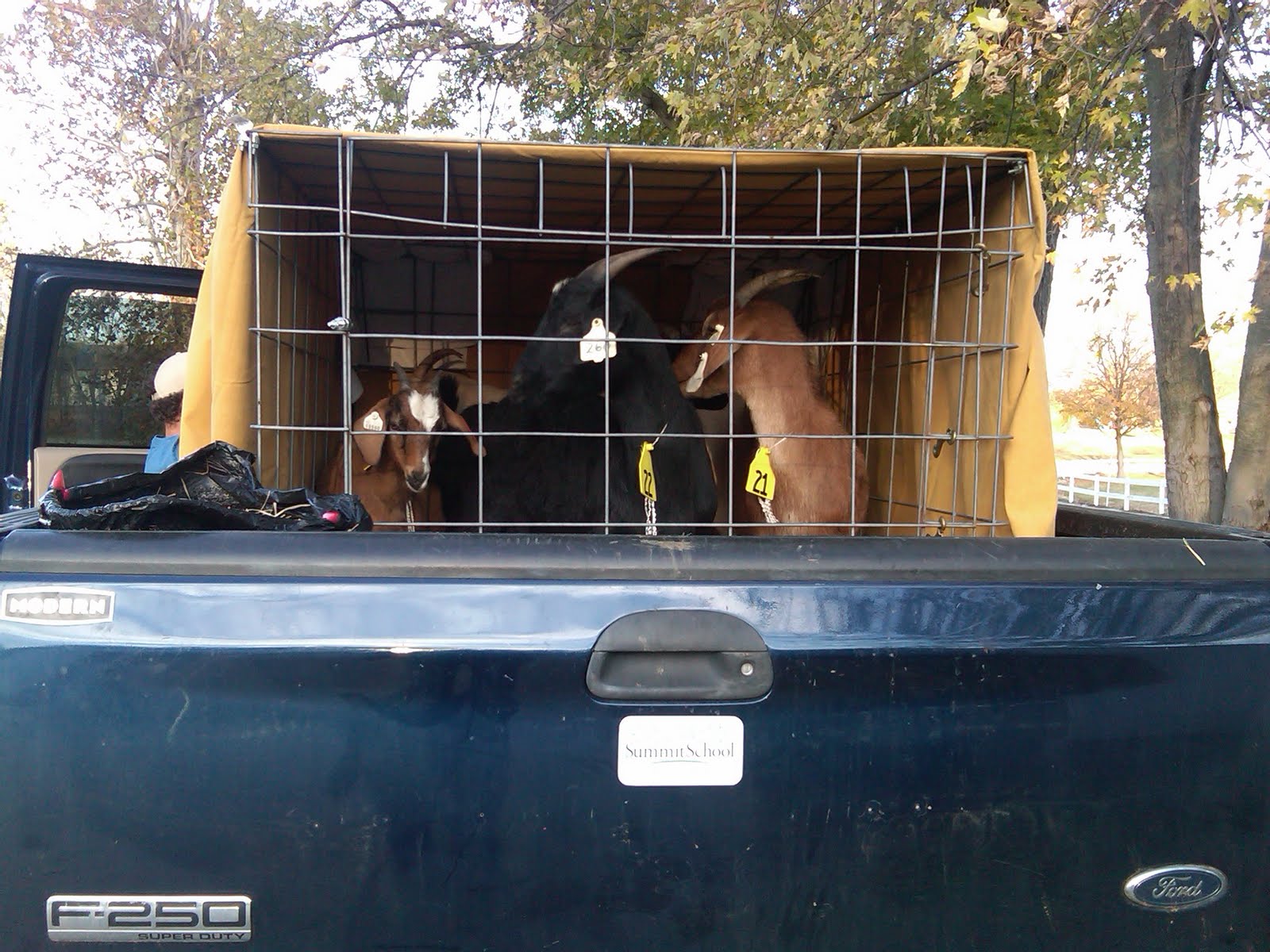
 Here is a picture of the does we purchased as they rounded the corner towards the loading pen. We bought three bred does, and two 2010 doelings. As I had planned, I have stacked the deck with Terminator bloodlines in my quest for some tough goats. I have that bloodlines in both the Wild Bill goats and also a Turbo doe bred to Cherokee Fiddler. Fiddler is closely related to a doe we bought last year who is bred this year for the first time. This doe's younger sister brought $2500 at the sale bred to Fiddler.
The drive home was a long one, and we ended up taking several naps at rest stops. I don't know if it is better for the goats to just get on to their destination, or if periodic stops allow them more time to rest. They ate a good bit of the grass hay we had in there on the way home, so they didn't let the trip bother them too much. Here are a few pictures of them on the farm to which we will be moving the rest of the bred does as soon as then fence is done. We made a quarantine area of goat panels we can move around out in the weeds. Since they are due between January and March, we may just keep them in a pen like this until they kid out.


As is always the case, we got to see a bunch of goat folks that are becoming friends. This is a good community of people from diverse backgrounds but with a common interest. I see a lot of collaboration, and a lot of people who are willing to share their hard earned knowledge with anyone, just for the asking. I think that spirit of "we are all in this together" will go a long way in keeping the Kiko industry growing in the future.
Now I will start working on my next post with some pictures of our bred does... but a sick young'un takes precedence. I hope we can take the kids with us to Corydon next year. They had a great Halloween festival and since our kids' hopes to go door to door trick or treating were turned topsy turvy by the Saturday vs Sunday thing and one being too sick to really go, we owe them a big Halloween next year.
Saturday, September 4, 2010
Can't lose focus...
It never ceases to amaze me how time flies. With my daughter's recent entry into the world of academia (she started JrK this year) I am taken back to my own childhood. A day was big and wide open and it seemed like there was hardly any way to fill all the hours until the sun would go down. Summers seemed endless. These days, in adulthood, a month can be gone in the blink of an eye.
This was one of those months. We had some trouble with a few goats with parasites late last month, proving again that while Kikos are about the toughest goats going, they aren't bulletproof and they are still living breathing creatures. Looking back on it, we set ourselves up for the perfect storm and then mother nature, in the form of torrential downpour after torrential downpour, decided to remind us we need to keep focus and mind the basics or we'd get bit in the butt.
Prior to what seemed like two or more inches of rain a day for about two weeks, we had had a bit of a drought. We like to feed lespedeza hay in the summer in addition to leaving some grass hay out in case anyone feels the need for long fiber. Our fenced areas are small, so reducing the egg count being redeposited in them is a factor we have to consider.
I also hate to use chemical dewormers at all, because every time I do, I am breeding stronger parasites. Most of the time, with the goats we have, this works out for us so long as we use a little sense in our management practices and do what we can to keep the parasites eggs in the pasture in check. We got busy, though, and pulled a stupid and ran out of lespedeza hay. When mother nature chose to let loose with the rains, all those parasite eggs that had been deposited during the period of zero rain apparently hatched at once. Kaboom. A few goats with scours and light eyes. And us scrambling to play catch up.
Now that we're getting back under control, I am making note of what we found. Most of the goats stayed wonderfully red-eyed and healthy as could be during this. Who suffered? The young, low on the social totem pole does who kidded in late spring... the very old... and the very young. All this makes sense. What will I do differently? Well, since my work schedule has been out of control to the point I have not even been able to get up to the goats to help Chuck - it's all on him at the moment. He has been doing famacha checks every few days to make sure everyone is remaining stable (except on the wil d ones. But he is an opportunist - one of the wild ones was stuck in the hay feeder when he arrived the other day so he took full advantage of the situation and her eyes were about a 2).
 d ones. But he is an opportunist - one of the wild ones was stuck in the hay feeder when he arrived the other day so he took full advantage of the situation and her eyes were about a 2).
 If I have does kid out late next spring, which I don't plan to have happen anyway, I might try dosing them with copper wire particle boluses right after kidding. If this doesn't give them the edge they need, I may try a chemical dewormer, or if she doesn't have just amazing mothering skills, I might move that goat on down the road to someone who needs a tough brush clearer. I'll have to see how it goes. We're certainly finding who seems to stay healthy no matter what, and that's valuable information. Boomer continues to have Famacha scores of 1. His main stressor has been me changing the doe groups around, but that stresses them much more than it bothers him. He is always happy to meet new does. The young Wild Bill son we are keeping to try out as a herd sire is a red eyed quick growing son of a gun too, even though he is a strange looking dude. I just hope both of them pass the positive traits along. Here again, only time will tell.

After the weeks of rain, we've had another period of pretty much zero rain. The pasture we planted on the new farm, where we plan to winter the does, ain't lookin' too grand. We have the soil samples ready to ship out, but we took advantage of a forecast of rain for this afternoon and had a local company come spread us some lime. Even without the benefit of what the soil sample will tell us, it has been a while since this farm was limed, and we run acidic around here just as a general rule. I want to get some varied forage planted in the areas where the orchardgrass and alfalfa didn't take; some winter peas, which should also improve the soil long term, and some kale and maybe even some turnips in spots, in addition to the standard winter wheat or rye. And the rain this afternoon has been a sight for sore eyes. Slow, gentle, and cool. Now if only it doesn't wait another month to rain again.
Friday, August 13, 2010
Beating the heat.
 Just a quick shot of Bo and Ralph doing their best to endure the heat. Bo has expanded Ralph's tunnel under the shed, and frequently we see only his eyes peeping up into the shed itself. Bo was born in mid April, and Ralph will be a year this October. She was 70lbs at her last checkup, even with the heat. I'm thinking Bo is going to be a big boy.
 Here is another one of the boys from this season. Steel is getting ready to move back to the country as soon as we complete the new buck pen encompassing a blackberry patch thick enough I'm not even sure they will be able to move around in it. It needs trimmed back and they need to earn their keep, so we just need to get the panels up and posts in.
 We bought a doe last year heavy bred to Wild Bill, a Terminator XX son. Since toughness and parasite resistance are our goals, we wanted to add some Terminator blood to the herd. So far, Ace is living up to the Terminator reputation. He has his mother's frame and so does his sister, so if he keeps on looking promising, we may use him to test breed a few does late this fall. The first item on his agenda, though, is the blackberry bushes...
Thursday, August 12, 2010
Getting the right mix...
 Well, breeding season is well underway up on the farm. We have, for the most part, the does where we want them so we can with any luck start kidding out in December. Chuck reports back when he sees activity, and I record it in the calendar with the tentative due date. Now, we just have to keep everyone healthy until it is time to move them to the other farm sometime in November. We have had a record number of days over 90 degrees, and I wonder how it will affect fertility. Obviously the days are beginning to shorten triggering the does to come in, but I wonder if their bodies will respond to the heat with reduced ovulation or if it won't matter at all. I suppose I will start getting my answers this December.
We finally got the weanling does moved to the country. So far, they have adjusted well and only little Tempy continues to try to get herself killed. She is the smallest of the bunch, but spends all of her time foraging even when everyone else is taking it easy in the shade, so I hope she does not eventually succeed in her attempts to eliminate herself from the gene pool. I have learned to appreciate the individuals who really get out and forage.
 Connie's doe kid continues to thrive even with the heat. We hope Connie rebreeds so she can kid out closer to the rest of the group next time, but that may not happen until next year. I have tried to keep the late kidding does fed well enough to raise their kids and keep a reasonable body condition so they may still continue their own growth but still rebreed and produce kids for this winter. Again, come December, I will know if this worked or if it was just feed wasted. If so, I can make better decisions next year. I don't mind providing extra feed for a doe doing double or triple duty, especially if she herself is still growing. It's the freeloaders I have a bit of a problem with.
Friday, July 30, 2010
the July kid

Connie's doe kid is still growing, although we have thought a couple times she might have been a coyote snack. Chuck could not find where Connie had her hidden away, so we thought when the tree fell across the fence and shorted it, an opportunistic predator may have taken advantage of the situation. Last weekend we took Bo, the Anatolian puppy, to the country to become acquainted with his future territory. We put him in "area 3" and set about our business putting one of those portable sheds together to cover some hay. About an hour later, I walked down the hill and hollered and hollered - but, no Bo. In my efforts to find him, I found the tiny cave under a huge pile of pushed in sticks where Connie's doeling had been hidden safely away. It took Chuck another hour or so to find Bo, who had found a nice cool spot next to a stump about in the middle of the woods, and who had no real intention of leaving that nice cool spot (did I mention we picked the day with the 110 degree heat index to do all this?). Within the past few days Connie's doeling has started to join the group, mainly full of long yearlings and mature does being bred for December and January kids.

Saturday, July 17, 2010
Looks like I'll have to get Chuck a new hat

Because he is going to have to eat one of his old ones. He went to the country today to check the goats between storms (which were keeping me busy on call) and I received a text from him stating "one doe. All okay." One doe? One? I texted back asking him if he was sure another one hadn't washed away. Nope. Jabba the Hutt had one doe. She's a first timer, so I wouldn't be surprised with a single if she had been a little smaller. She is figuring out this whole mom thing, and has a good supply of milk and the doeling is getting her colostrum, so now we just have to watch her grow and assess Connie's mothering abilities and her new doe kid's own qualities and see what we've got.

Subscribe to:
Posts (Atom)
